
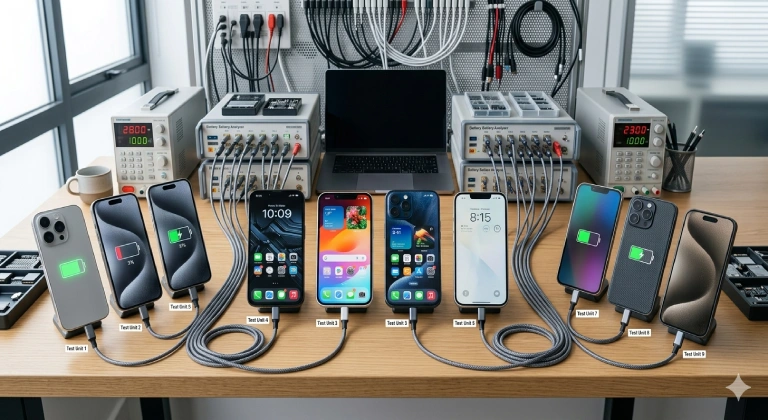
Battery Drain Test – Which Smartphone Lasts the Longest?
Battery life is one of the most important things to consider when buying a smartphone. A phone can have a powerful processor, an excellent camera, a bright display, and premium design, but none of that matters much if the battery runs low before the end of the day.
That is why a smartphone battery drain test can be more useful than simply looking at the battery capacity printed on a specification sheet.
A larger battery does not automatically mean longer battery life. Processor efficiency, display technology, refresh rate, software optimization, cellular connectivity, brightness, background activity, and the type of work you do on the phone can all change how quickly the battery falls.
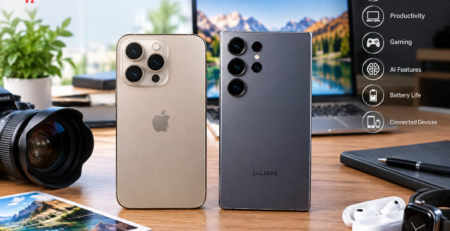
For this comparison, we are looking at two current flagship examples: the iPhone 18 Pro Max and Samsung Galaxy S26 Ultra. They provide an interesting comparison because both offer large displays, flagship processors, advanced cameras, fast charging, and batteries designed for all-day use.
Independent testing also gives us a more useful picture than manufacturer claims alone. In a standardized Tom’s Guide test using continuous web surfing over 5G at 150-nit brightness, the iPhone 18 Pro Max reached 18 hours and 27 minutes, while the Galaxy S26 Ultra reached 16 hours and 40 minutes in standard display mode and 16 hours and 10 minutes with adaptive mode.
So, which smartphone lasts the longest? The answer depends on the test, but the available standardized results give us a strong starting point.
1. The Two Smartphones in This Battery Drain Test
Before looking at battery endurance, it is important to understand the two phones being compared.
The iPhone 18 Pro Max and Galaxy S26 Ultra are both premium flagship smartphones, but they take different approaches to hardware, software, displays, and battery management.
1.1 iPhone 18 Pro Max
The iPhone 18 Pro Max is Apple’s largest 2026 Pro iPhone. It features a 6.9-inch Super Retina XDR OLED display with ProMotion up to 120Hz and Apple’s A20 Pro processor.
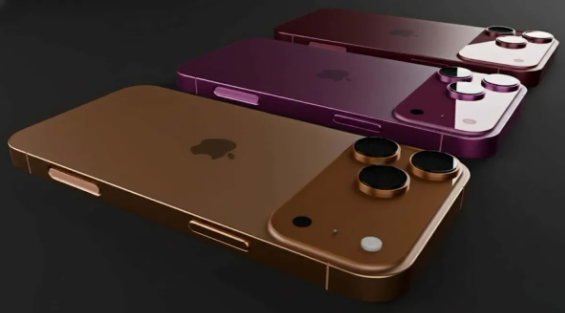
Apple rates the iPhone 18 Pro Max for up to 30 hours of typical use, up to 45 hours of video playback, and up to 40 hours of streamed video playback under Apple’s testing conditions. Apple also says it can reach up to 50% charge in around 15 minutes when paired with a 60W-capable adapter or higher.
Price
The iPhone 18 Pro Max starts at $1,299 in the U.S. for the 256GB model.
Best for
- Long battery endurance
- iOS users
- Video streaming
- Mobile photography and video
- Heavy daily smartphone use
- Users already invested in Apple’s ecosystem
Key specifications
Feature |
iPhone 18 Pro Max |
|---|---|
| Display | 6.9-inch Super Retina XDR OLED |
| Refresh rate | Up to 120Hz ProMotion |
| Processor | A20 Pro |
| Storage | 256GB, 512GB, 1TB, 2TB |
| Typical use | Up to 30 hours |
| Video playback | Up to 45 hours |
| Streamed video | Up to 40 hours |
| Fast charging | Up to 50% in around 15 minutes with suitable 60W+ adapter |
| Weight | 249g |
Apple’s official specifications confirm these battery figures and charging capabilities.
Why consider it?
The biggest reason to consider the iPhone 18 Pro Max for battery life is not simply battery capacity. Apple’s hardware and software are designed together, and the A20 Pro platform is paired with a new thermal-management system and battery design.
Apple says the iPhone 18 Pro Max delivers its largest increase in battery life ever on an iPhone, with improvements coming from Apple silicon efficiency and a larger battery.
Pros
- Excellent tested battery endurance
- Strong video playback rating
- Efficient flagship processor
- Fast wired charging
- Excellent ecosystem integration
- Large 6.9-inch display
Cons
- Heavy compared with many smartphones
- Expensive starting price
- Large physical size may not suit everyone
- Apple’s official battery figures use specific testing conditions and should not be treated as universal real-world runtime.
1.2 Samsung Galaxy S26 Ultra
The Samsung Galaxy S26 Ultra is Samsung’s flagship Galaxy smartphone for 2026. It combines a 6.9-inch Dynamic AMOLED 2X display, Snapdragon 8 Elite Gen 5 for Galaxy processor, and a 5000mAh battery.
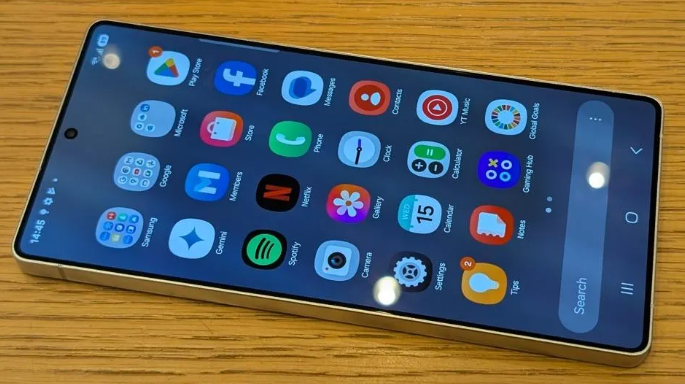
Samsung officially rates the phone for up to 31 hours of video playback and says it can reach up to 75% charge in around 30 minutes. Samsung lists the typical battery capacity at 5000mAh.
Price
The Galaxy S26 Ultra has a U.S. list price of $1,299.99 for 256GB, with higher storage tiers priced at $1,499.99 and $1,799.99. Samsung’s store can also show temporary promotions, so live pricing may be lower at the time of purchase.
Best for
- Android users
- Large-display users
- Gaming
- Multitasking
- Long video playback
- Users who want Samsung’s camera and Galaxy features
Key specifications
Feature |
Galaxy S26 Ultra |
|---|---|
| Display | 6.9-inch Dynamic AMOLED 2X |
| Refresh rate | Adaptive up to 120Hz |
| Processor | Snapdragon 8 Elite Gen 5 for Galaxy |
| Battery | 5000mAh typical capacity |
| Video playback | Up to 31 hours |
| Fast charging | Up to 75% in around 30 minutes |
| Weight | 214g |
| Thickness | 7.9mm |
Samsung confirms the 5000mAh battery, 31-hour video claim, 6.9-inch display, and charging figures on its U.S. product page.
Why consider it?
The Galaxy S26 Ultra combines a large battery with an adaptive high-refresh-rate display and a flagship Qualcomm platform. Samsung also emphasizes improved heat management, which can help maintain performance during demanding workloads such as gaming and multitasking.
Pros
- Large 5000mAh battery
- Excellent display
- Up to 120Hz adaptive refresh rate
- Strong video-playback rating
- Fast wired charging
- Large, versatile flagship platform
Cons
- Large display can consume substantial power at high brightness and refresh rates
- Heavy workloads can increase battery drain
- Actual battery life varies considerably with settings and network conditions
- Manufacturer video-playback figures are not directly comparable with Apple’s figures.
Official U.S. buying page.
2. How Does a Smartphone Battery Drain Test Work?
A meaningful battery drain test needs a consistent methodology.
If one phone is tested at 100% brightness while another is tested at 50%, the result will not tell us much. The same problem occurs if one phone uses Wi-Fi while another relies on 5G.
That is why standardized testing is useful.
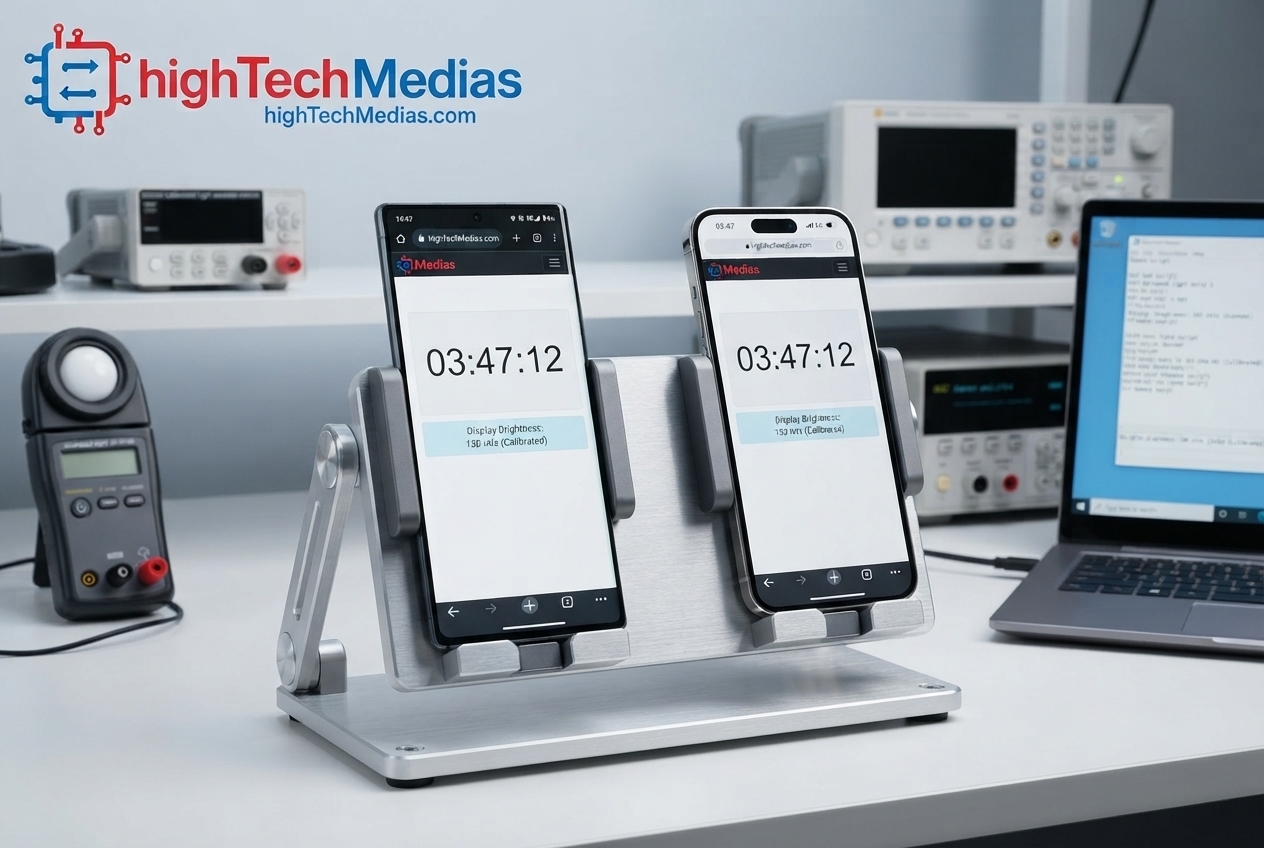
For the independent results discussed in this article, Tom’s Guide used a continuous web-surfing test over 5G with the screen brightness calibrated to 150 nits. The test continues until the battery is depleted.
This type of test is particularly useful because web browsing represents a common smartphone workload. It combines:
- Display usage
- Cellular connectivity
- Processor activity
- Network communication
- Web rendering
- Background system processes
- Battery management
It is different from a simple video playback test.
A phone might perform extremely well during continuous video playback but behave differently during 5G browsing, gaming, camera use, or navigation.
Why 150 nits matters
Display brightness has a major effect on battery consumption.
A smartphone operating at maximum brightness can consume considerably more power than the same device at a moderate brightness level. Standardizing brightness therefore makes comparisons more meaningful.
The same principle applies to network conditions. A weak cellular signal can force a phone to work harder to maintain communication, potentially increasing battery drain.
3. iPhone 18 Pro Max Battery Life Test
Apple’s official numbers are impressive, but independent testing gives us another perspective.
In recent official’s Guide’s standardized battery test, the iPhone 18 Pro Max averaged 18 hours and 27 minutes of continuous web surfing over 5G at 150 nits. Its longest recorded run in that test was 18 hours and 41 minutes.
4. Galaxy S26 Ultra Battery Life Test
Samsung equips the Galaxy S26 Ultra with a typical 5000mAh battery and officially claims up to 31 hours of video playback.
The more interesting question is how it performs under a standardized battery endurance test.
Tom’s Guide measured the Galaxy S26 Ultra at 16 hours and 40 minutes in standard display mode. With adaptive display mode enabled, the result was 16 hours and 10 minutes.
This demonstrates why smartphone battery tests need to explain their settings.
The Galaxy S26 Ultra has an adaptive 120Hz display. Depending on what the phone is doing, the display can adjust its refresh behavior, but higher refresh rates and brightness can affect power consumption.
The 30-minute difference between the tested configurations also shows why two people can get different battery results from the same smartphone.
A user who spends most of the day reading static webpages at moderate brightness may see different battery behavior from someone who plays games, records 4K video, uses GPS, or keeps the screen very bright.
5. Head-to-Head Smartphone Battery Drain Test Results
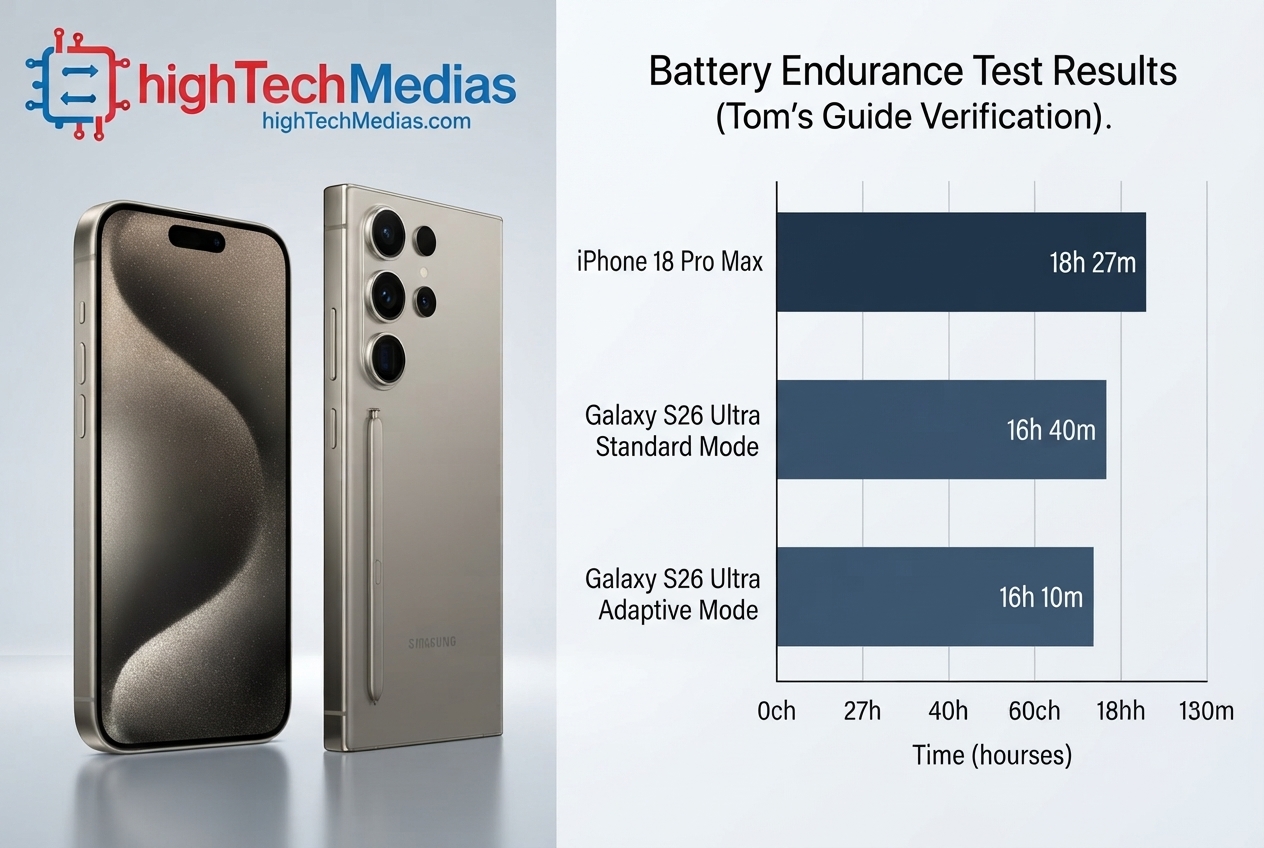
Now we can compare the independent results under the same general test methodology.
| Smartphone | Battery/Test Result |
|---|---|
| iPhone 18 Pro Max | 18h 27m |
| Galaxy S26 Ultra — Standard display | 16h 40m |
| Galaxy S26 Ultra — Adaptive display | 16h 10m |
Tom’s Guide’s results put the iPhone 18 Pro Max approximately 1 hour and 47 minutes ahead of the Galaxy S26 Ultra in standard display mode. Compared with the Galaxy in adaptive mode, the difference is approximately 2 hours and 17 minutes.
That is a significant difference in a continuous battery endurance test.
However, it should not be interpreted as meaning the iPhone will always last exactly two hours longer in everyday use.
Real battery life depends on:
- Cellular signal strength
- Wi-Fi usage
- Screen brightness
- Refresh rate
- Gaming
- Camera recording
- GPS
- Bluetooth
- Streaming quality
- Background applications
- Operating-system settings
- Ambient temperature
- Battery health
The result is best understood as a controlled endurance measurement, not a promise of how many hours every user will get.
6. Does a Bigger Battery Always Last Longer?
No.
Battery capacity is important, but it is only one part of the equation.
The Galaxy S26 Ultra has a listed typical battery capacity of 5000mAh. Apple does not publish the iPhone 18 Pro Max’s battery capacity in its official technical specifications, so it would be misleading to invent or present an unofficial mAh number as Apple’s official specification.
What matters is how efficiently the phone turns stored battery energy into useful work.
Consider everything consuming power inside a modern smartphone:
- Processor
- Display
- Modem
- Cameras
- Speakers
- GPS
- Wi-Fi
- Bluetooth
- Storage
- Background applications
- AI processing
A highly efficient processor can complete a task using less energy. An efficient display can reduce power consumption. Software can also control background activity and processor performance.
This is why battery capacity and battery endurance are not the same thing.
The Galaxy S26 Ultra’s 5000mAh battery is a useful specification, but the iPhone 18 Pro Max’s independent endurance result demonstrates that capacity alone cannot determine which phone lasts longer.
7. Charging Speed: Which Phone Recovers More Quickly?
Battery endurance is only half of the battery story.
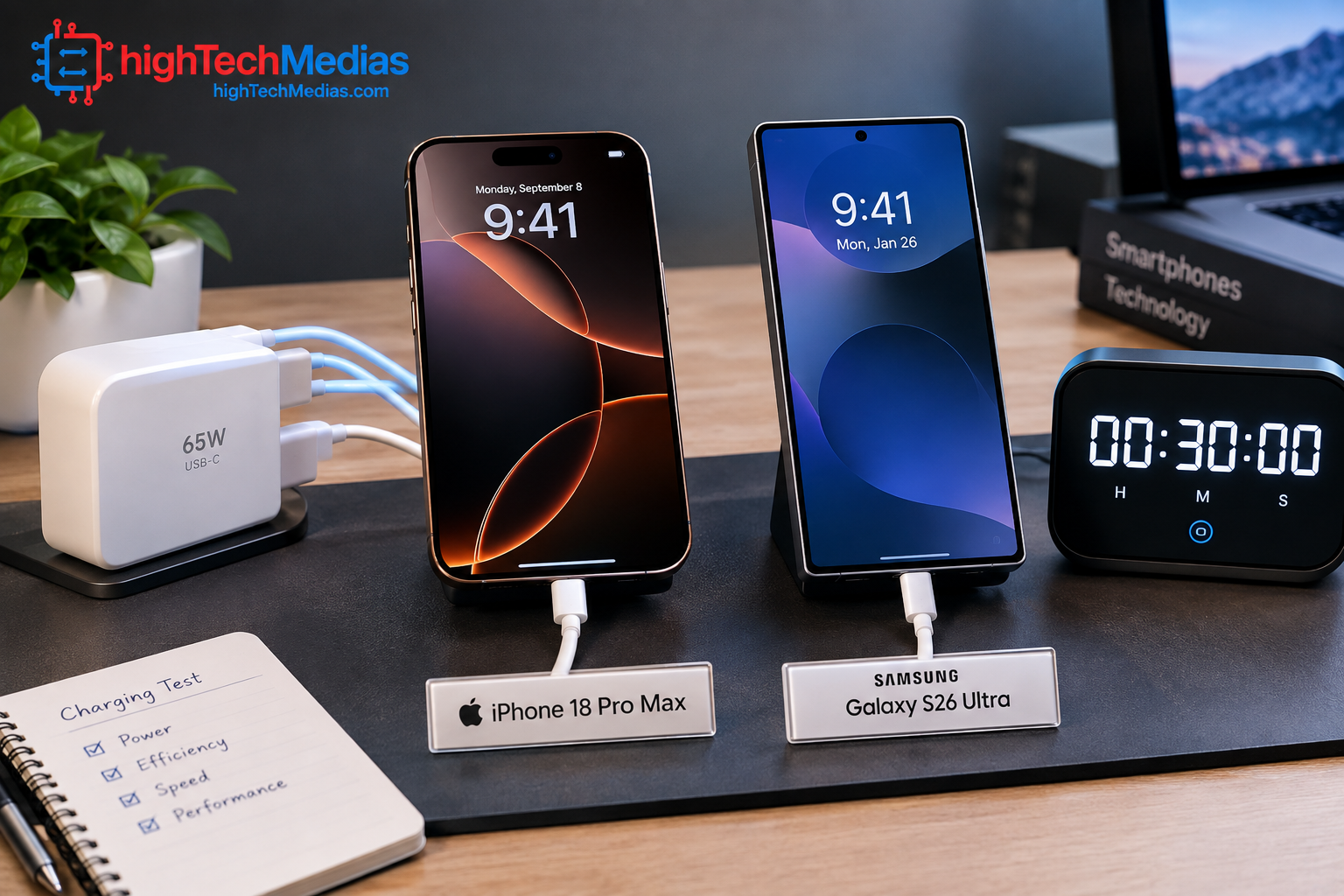
Charging speed matters because even a phone with excellent endurance eventually needs to be connected to a charger.
Apple says the iPhone 18 Pro Max can reach up to 50% in around 15 minutes using a 60W-capable adapter or higher with the appropriate USB-C charging setup.
Samsung says the Galaxy S26 Ultra can reach up to 75% in around 30 minutes.
These manufacturer claims use different charging methodologies, so they should not be treated as a laboratory head-to-head comparison.
Independent testing also provides additional context. Tom’s Guide reported that the iPhone 18 Pro Max reached 44% after 15 minutes and 77% after 30 minutes in its charging test.
For people who frequently forget to charge their phones overnight, fast charging can be almost as important as maximum battery endurance.
A five- or fifteen-minute charging session during breakfast, a commute, or a work break can restore a meaningful amount of usable battery.
8. Gaming, Streaming, and Heavy Smartphone Use
A battery drain test based on web browsing does not tell the entire story.
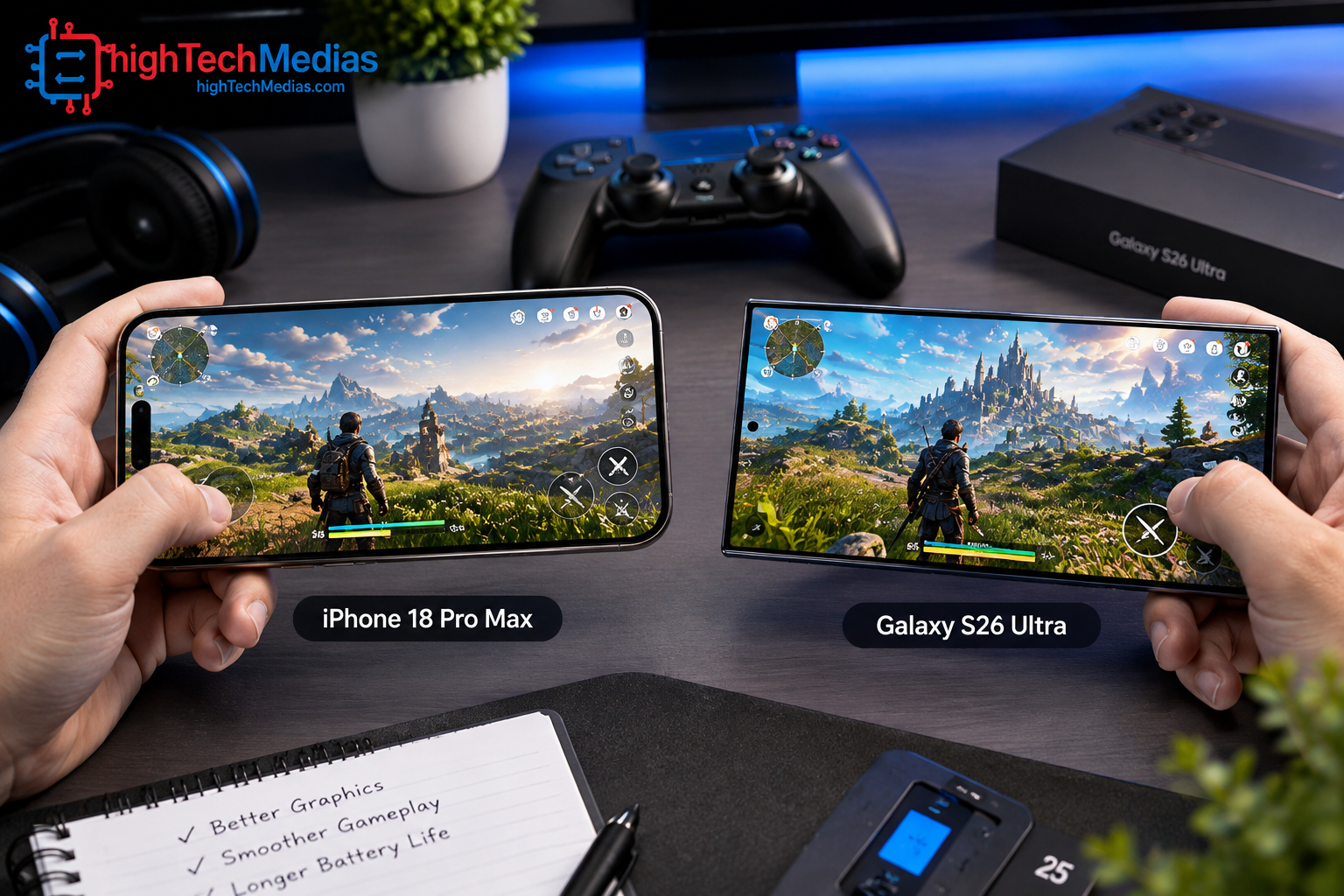
Gaming can be much more demanding because it places sustained pressure on the CPU and GPU while keeping the display active.
Graphics-heavy games can increase:
- Processor usage
- GPU usage
- Display power consumption
- Heat generation
- Network activity
The result can be substantially different from simple messaging or reading.
The same applies to video recording. Recording high-resolution video requires camera sensors, image processing, storage, processor activity, and display use.
Streaming video over 5G can also consume more power than watching a locally stored video because the cellular modem remains active.
For readers interested in smartphone gaming performance and game choices, see our guide to Top Mobile Games in 2026: Best Picks for Every Gamer.
The important point is simple: there is no single battery-drain workload that represents every smartphone user.
Someone who mostly sends messages and reads email may get excellent battery life from almost any modern flagship. A heavy gamer or frequent video creator will place much greater demands on the battery.
9. Which Smartphone Is Better for Different Types of Users?
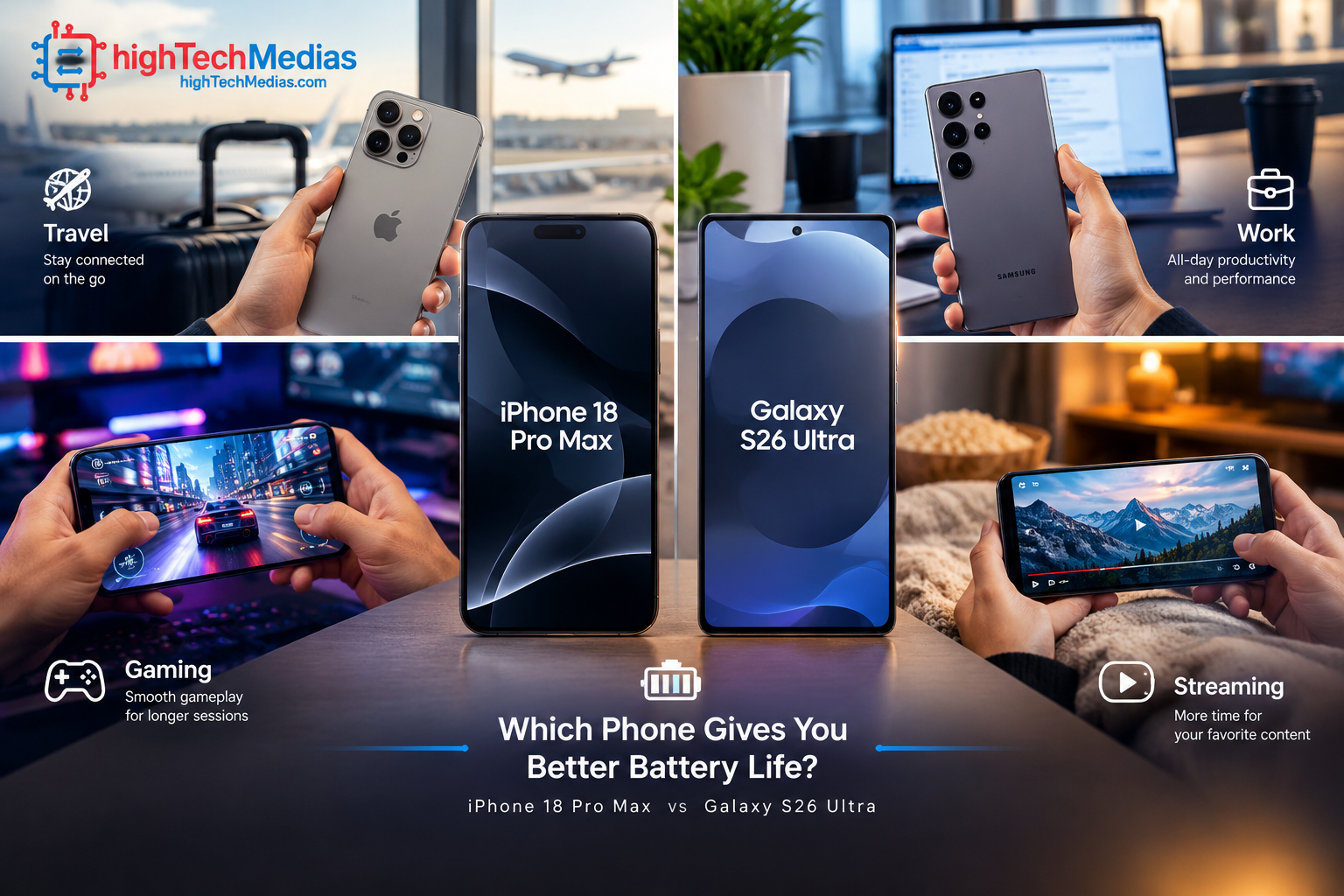
The question “which smartphone lasts the longest?” has a straightforward answer in a standardized test, but buying decisions are more personal.
For heavy web browsing
The Tom’s Guide result gives the iPhone 18 Pro Max a longer continuous runtime under its 5G web-browsing methodology.
For video playback
Both manufacturers publish strong video-playback figures, but the numbers come from different testing conditions. Apple rates the iPhone 18 Pro Max for up to 45 hours of video playback, while Samsung rates the Galaxy S26 Ultra for up to 31 hours.
These figures should therefore be treated as manufacturer-specific claims rather than a perfectly controlled comparison.
For gaming
Both phones use flagship processors and large displays. Gaming battery consumption will depend heavily on graphics settings, frame rate, brightness, network connectivity, temperature, and the specific game.
For frequent travelers
Battery endurance becomes particularly important when access to a charger is limited.
A long-distance traveler may value both strong endurance and fast charging. In that situation, looking only at battery capacity is not enough.
For professionals
Professionals who spend hours browsing, emailing, attending video meetings, navigating, and using cloud applications should pay particular attention to independent endurance tests.
For a broader look at current flagship smartphones, see our Top 10 Smartphones in 2026: Ultimate Guide.
10. Price and Value in the U.S.
Battery life is only one part of a smartphone purchase, and both phones sit firmly in the premium flagship category.
The iPhone 18 Pro Max starts at $1,299 in the U.S. for 256GB.
The Galaxy S26 Ultra’s listed 256GB price is $1,299.99, although Samsung’s store can show temporary discounts and promotional pricing.
That makes the starting prices remarkably close.
For buyers comparing the two, therefore, battery life should be considered alongside:
- Camera quality
- Operating system
- Display
- Processor performance
- Storage
- Charging
- Software support
- Ecosystem
- Gaming requirements
- Accessories
- Personal preferences
If you are already comparing these two flagships beyond battery life, our iPhone 18 Pro Max vs Samsung Galaxy S26 Ultra comparison provides additional context.
11. How to Make Your Smartphone Battery Last Longer
Even a smartphone with excellent battery endurance can drain quickly when configured for maximum performance.
Here are practical ways to reduce unnecessary battery drain.
Reduce unnecessary display brightness
The display is one of the biggest sources of power consumption. Use automatic brightness or a comfortable manual level instead of maximum brightness whenever possible.
Use adaptive refresh rates
If your phone supports an adaptive refresh rate, allowing the device to adjust refresh rate according to the workload can help balance smoothness and power consumption.
Check background apps
Apps running in the background can consume battery through synchronization, location services, notifications, and network activity.
Review which applications are consuming the most power.
Manage location access
GPS and continuous location tracking can increase battery usage.
Give location access only to apps that genuinely need it.
Use Wi-Fi when practical
Cellular connectivity can consume more energy under some conditions, particularly when signal strength is poor.
When reliable Wi-Fi is available, connecting to it can reduce cellular modem activity.
Avoid excessive heat
High temperatures can accelerate battery degradation and affect short-term battery performance.
Avoid leaving your smartphone in direct sunlight or inside a hot vehicle.
Reduce unnecessary notifications
Constant notification activity can wake the display and trigger background processing.
Disabling unnecessary notifications can reduce small but repeated battery drains.
Use battery-saving modes when necessary
Battery-saving modes can restrict background activity and performance to extend remaining runtime.
They are particularly useful when you are traveling and cannot charge immediately.
12. Frequently Asked Questions
What is a smartphone battery drain test?
A smartphone battery drain test measures how long a phone can operate under a controlled workload before its battery is depleted. Common tests include web browsing, video playback, gaming, or mixed-use scenarios.
Which smartphone lasts the longest in 2026?
There is no single answer for every workload. In the standardized Tom’s Guide 5G web-browsing test discussed here, the iPhone 18 Pro Max lasted 18 hours and 27 minutes, while the Galaxy S26 Ultra lasted 16 hours and 40 minutes in standard display mode and 16 hours and 10 minutes in adaptive mode.
Does a 5000mAh battery automatically mean better battery life?
No. Battery capacity is only one factor. Processor efficiency, display power consumption, software optimization, modem efficiency, brightness, refresh rate, and workload all affect battery endurance.
How long does the iPhone 18 Pro Max battery last?
Apple rates the iPhone 18 Pro Max for up to 30 hours of typical use, up to 45 hours of video playback, and up to 40 hours of streamed video playback under Apple’s specified conditions.
How long does the Galaxy S26 Ultra battery last?
Samsung lists the Galaxy S26 Ultra with a typical 5000mAh battery and rates it for up to 31 hours of video playback.
Does 120Hz drain more battery?
It can. A higher refresh rate requires the display to update more frequently, which can increase power consumption. Adaptive refresh-rate systems can adjust the refresh rate depending on the workload.
Does 5G drain a smartphone battery faster?
5G can increase battery consumption depending on network conditions, signal strength, modem behavior, and how the phone is being used. This is one reason controlled 5G battery tests are useful.
Is fast charging bad for battery health?
Modern smartphones are designed to manage charging safely, but heat is an important factor in long-term battery health. Charging behavior, temperature, battery chemistry, and charging management all influence battery aging.
Is battery capacity more important than battery efficiency?
Neither should be considered in isolation. A large battery provides more stored energy, while efficient hardware and software determine how effectively that energy is used.
13. Final Verdict: Which Smartphone Lasts the Longest?
The answer depends on what you mean by “lasts the longest.”
If we focus specifically on the standardized smartphone battery drain test discussed in this article, the available independent evidence gives the iPhone 18 Pro Max the longer runtime.
Tom’s Guide measured:
- iPhone 18 Pro Max: 18h 27m
- Galaxy S26 Ultra: 16h 40m in standard display mode
- Galaxy S26 Ultra: 16h 10m in adaptive mode
under its continuous 5G web-browsing test at 150 nits.
That gives the iPhone 18 Pro Max a measurable endurance advantage in that particular test.
However, that does not mean the iPhone will always last longer in every situation. Samsung’s Galaxy S26 Ultra has a 5000mAh battery and an official rating of up to 31 hours of video playback, while Apple’s iPhone 18 Pro Max is rated for up to 45 hours of video playback. Those manufacturer numbers use different testing conditions and should not be treated as a direct laboratory comparison.
The bigger lesson from this battery drain test is that smartphone battery life cannot be judged by mAh alone.
The best way to evaluate a phone is to consider battery capacity, processor efficiency, display behavior, network usage, charging speed, software optimization, and the workload you actually perform.
For someone primarily concerned with long endurance during standardized 5G web use, the iPhone 18 Pro Max’s independent result is particularly notable. For someone who values Samsung’s Android ecosystem, large AMOLED display, 5000mAh battery, fast charging, and other Galaxy features, the Galaxy S26 Ultra remains a powerful flagship option.
In other words, the smartphone that lasts the longest in a test is not necessarily the smartphone that will last the longest for every individual user. The workload matters just as much as the battery.


Comment (1)
[…] For a broader discussion of smartphone endurance, see our battery drain test: which smartphone lasts longest in 2026. […]