
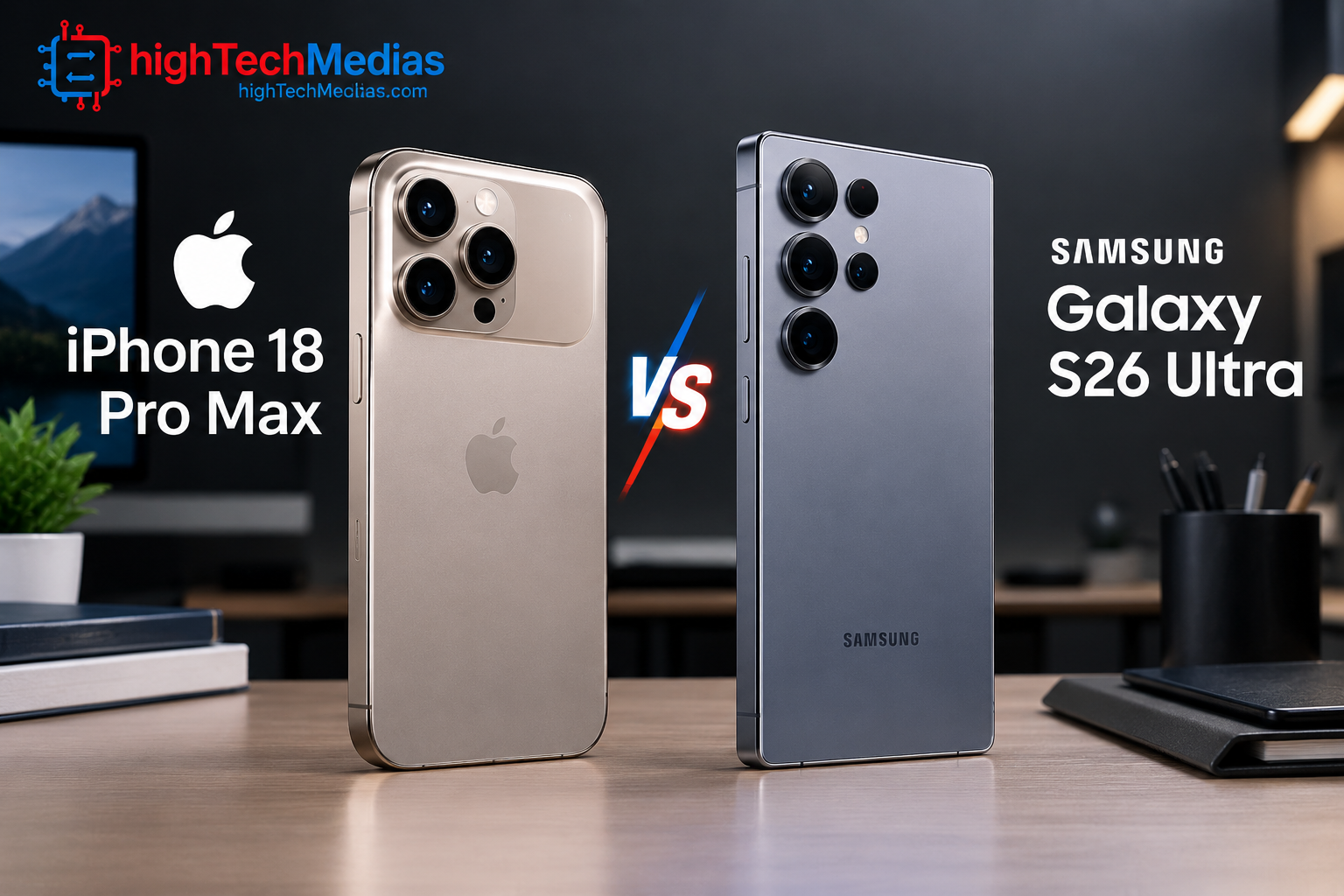
iPhone 18 Pro Max vs Samsung Galaxy S26 Ultra: Full Comparison
Choosing between Apple’s newest Pro Max iPhone and Samsung’s flagship Ultra phone is difficult because both devices target buyers who want premium performance, advanced cameras, long battery life, and powerful AI features.
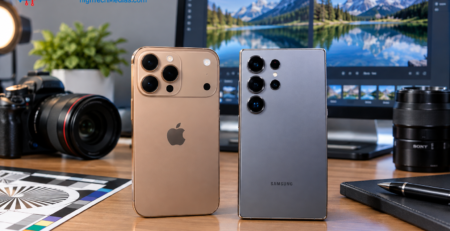
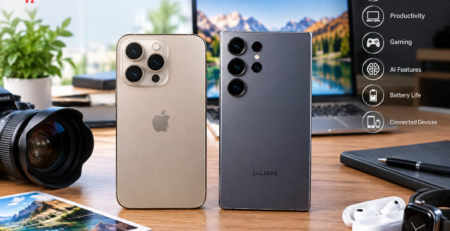
The iPhone 18 Pro Max vs Samsung Galaxy S26 Ultra comparison is particularly interesting in 2026 because both phones combine large 6.9-inch displays, flagship processors, advanced camera systems, 5G connectivity, and premium designs. However, they take different approaches to photography, software, AI, productivity, charging, and device customization.
The iPhone 18 Pro Max starts at $1,299 in the United States, while the Galaxy S26 Ultra launched at $1,299.99. Both are available with multiple storage configurations. Apple offers up to 2TB, while Samsung offers 256GB, 512GB, and 1TB configurations, with 16GB of RAM available on the 1TB version.
This comparison looks at their specifications, displays, performance, cameras, battery life, software, AI features, design, connectivity, and everyday usability so you can understand which phone better matches your needs.
1. iPhone 18 Pro Max vs Samsung Galaxy S26 Ultra: Key Specifications
Before examining individual features, it helps to see how the two flagship smartphones compare at a glance.
Feature |
iPhone 18 Pro Max |
Samsung Galaxy S26 Ultra |
|---|---|---|
| Starting price | $1,299 | $1,299.99 |
| Display | 6.9-inch Super Retina XDR OLED | 6.9-inch Dynamic AMOLED 2X |
| Refresh rate | Up to 120Hz ProMotion | Up to 120Hz adaptive |
| Processor | Apple A20 Pro | Snapdragon 8 Elite Gen 5 for Galaxy |
| Main camera | 48MP Fusion with variable aperture | 200MP wide |
| Ultra-wide | 48MP | 50MP |
| Telephoto | 48MP 4x | 50MP 5x + 10MP 3x |
| Front camera | 18MP Center Stage | 12MP |
| Battery | Apple does not publish mAh capacity | 5,000mAh |
| Video playback claim | Up to 45 hours | Up to 31 hours |
| Operating system | iOS 27 | Android with One UI |
| Stylus | No built-in stylus | Built-in S Pen |
| Storage | 256GB to 2TB | 256GB, 512GB, 1TB |
| Wi-Fi | Wi-Fi 7 | Wi-Fi 7 |
| Water resistance | IP68 | IP68 |
The specifications show that neither phone is simply a larger version of the other. Samsung emphasizes camera versatility, S Pen productivity, customization, Privacy Display technology, and fast charging, while Apple emphasizes sustained performance, video capabilities, photography controls, battery efficiency, and integration with its wider ecosystem.
2. Design and Build Quality
Both phones use premium materials, but their physical approaches are different.
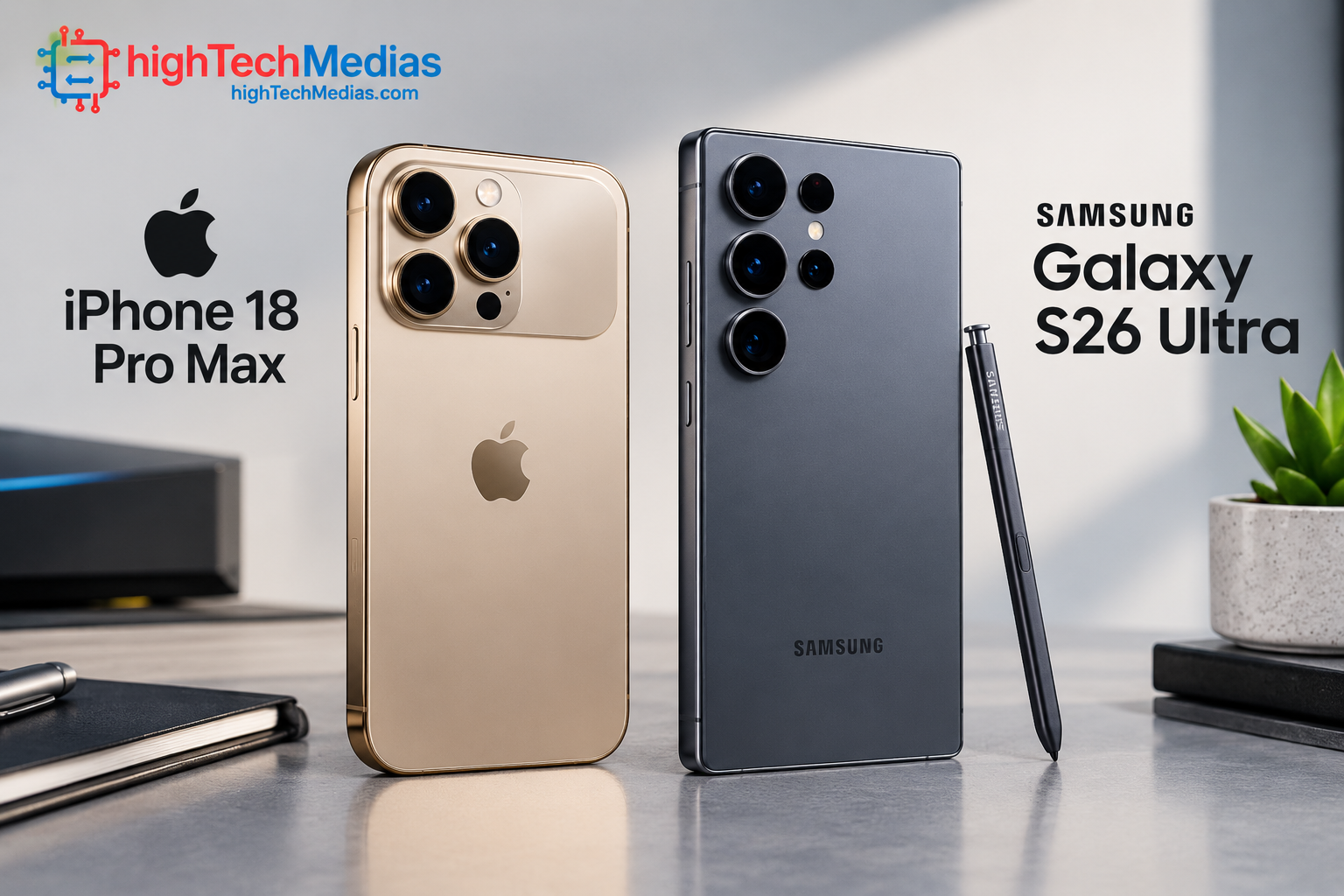
The iPhone 18 Pro Max measures 6.43 inches tall, 3.07 inches wide, and 0.34 inch thick. It weighs 249 grams and uses an aluminum unibody design with Ceramic Shield 2 on the front and Ceramic Shield on the back. Apple offers the phone in black, silver, glacier, and burgundy.
Samsung’s Galaxy S26 Ultra is slightly lighter at 214 grams and measures 7.9mm thick. Samsung offers several colors, including Cobalt Violet, White, Black, Sky Blue, Pink Gold, and Silver Shadow.
Both devices carry IP68 water and dust resistance ratings. Their large displays and premium construction make them substantial phones, but Samsung has a significant weight advantage.
The Galaxy S26 Ultra also incorporates its S Pen directly into the phone, something the iPhone does not offer. The S Pen supports handwriting, notes, translation, screen interaction, and other productivity functions.
3. Display Comparison
The two phones use similarly sized 6.9-inch displays, but their display technologies and software features differ.
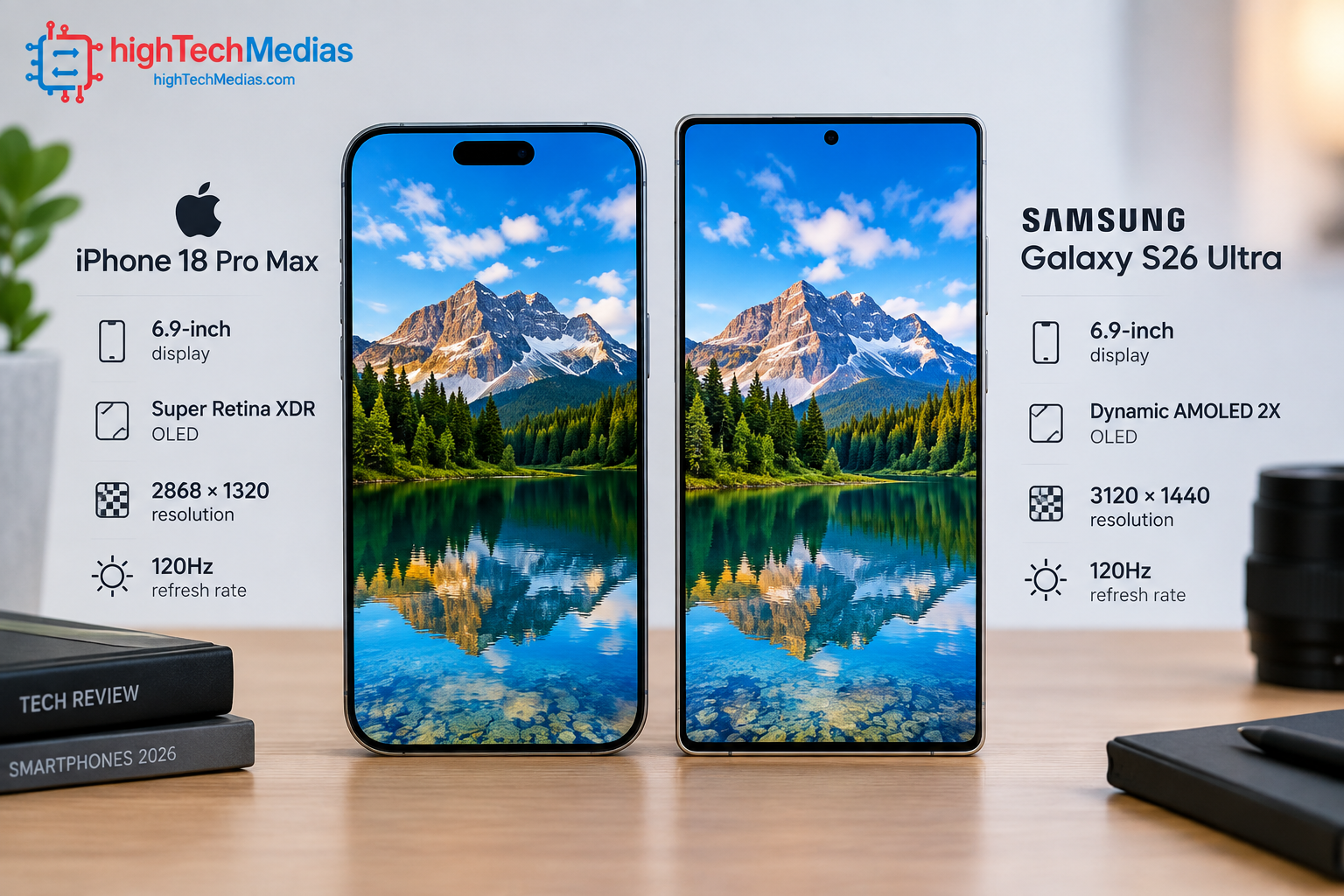
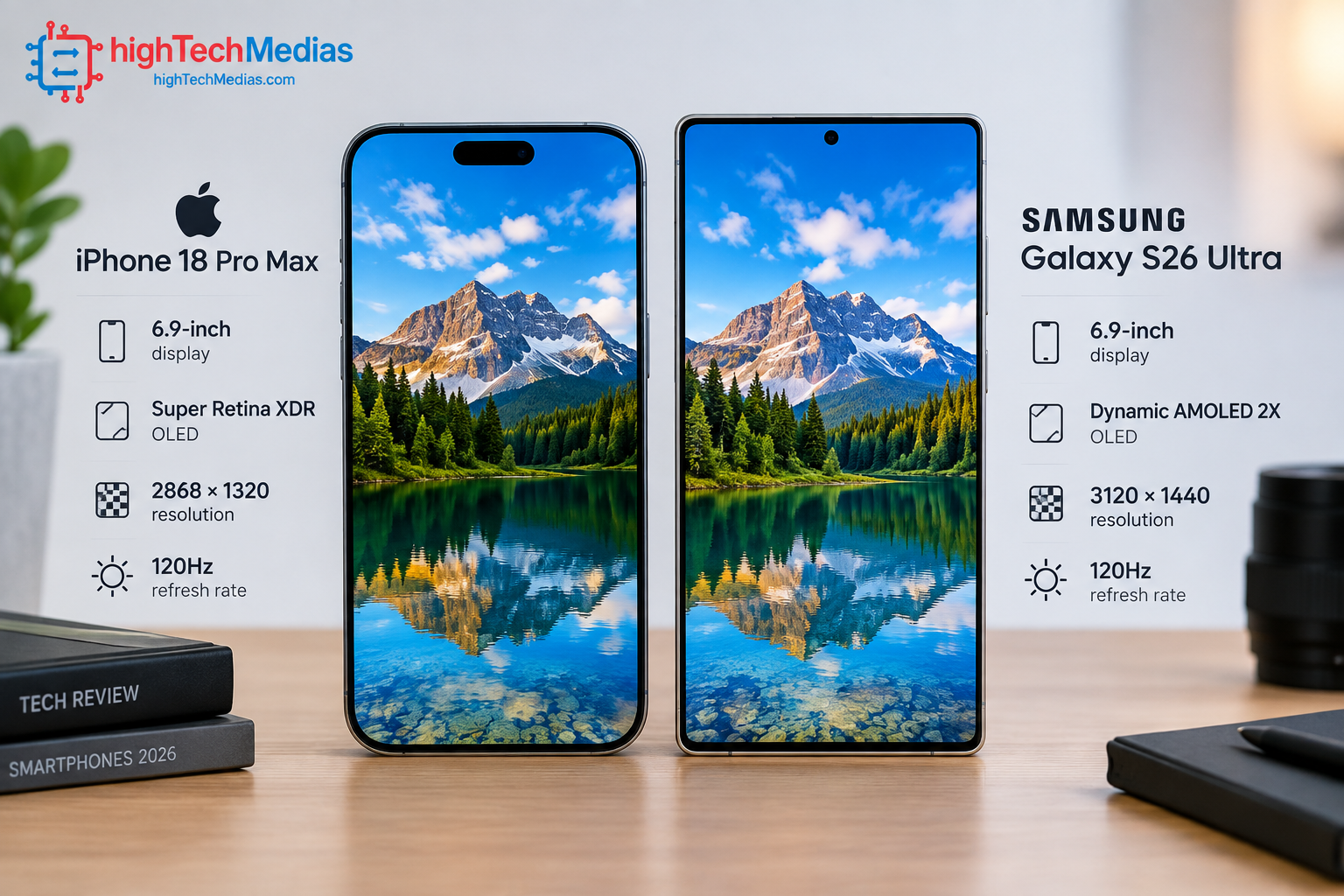
The iPhone 18 Pro Max uses a 6.9-inch Super Retina XDR OLED display with a 2868 × 1320 resolution and 460 pixels per inch. It supports ProMotion with adaptive refresh rates up to 120Hz, Always-On display functionality, HDR, True Tone, P3 wide color, and an anti-reflective coating. Apple lists typical brightness at 1,000 nits, HDR peak brightness at 1,600 nits, and outdoor peak brightness of 3,000 nits.
Samsung’s Galaxy S26 Ultra also uses a 6.9-inch panel, specifically a Dynamic AMOLED 2X display with up to 120Hz adaptive refresh. Samsung lists a peak brightness of 2,600 nits and has introduced a built-in Privacy Display designed to reduce visibility to people viewing the screen from an angle.
For conventional media consumption, both displays provide flagship-level image quality. Samsung’s Privacy Display adds a feature that can be particularly useful for people who frequently use their phones in public spaces.
The iPhone, meanwhile, combines its OLED display with ProMotion, Always-On functionality, strong outdoor brightness, and Apple’s color-management approach.
4. Processor and Performance
Performance is one of the most important parts of the iPhone 18 Pro Max vs Samsung Galaxy S26 Ultra comparison.
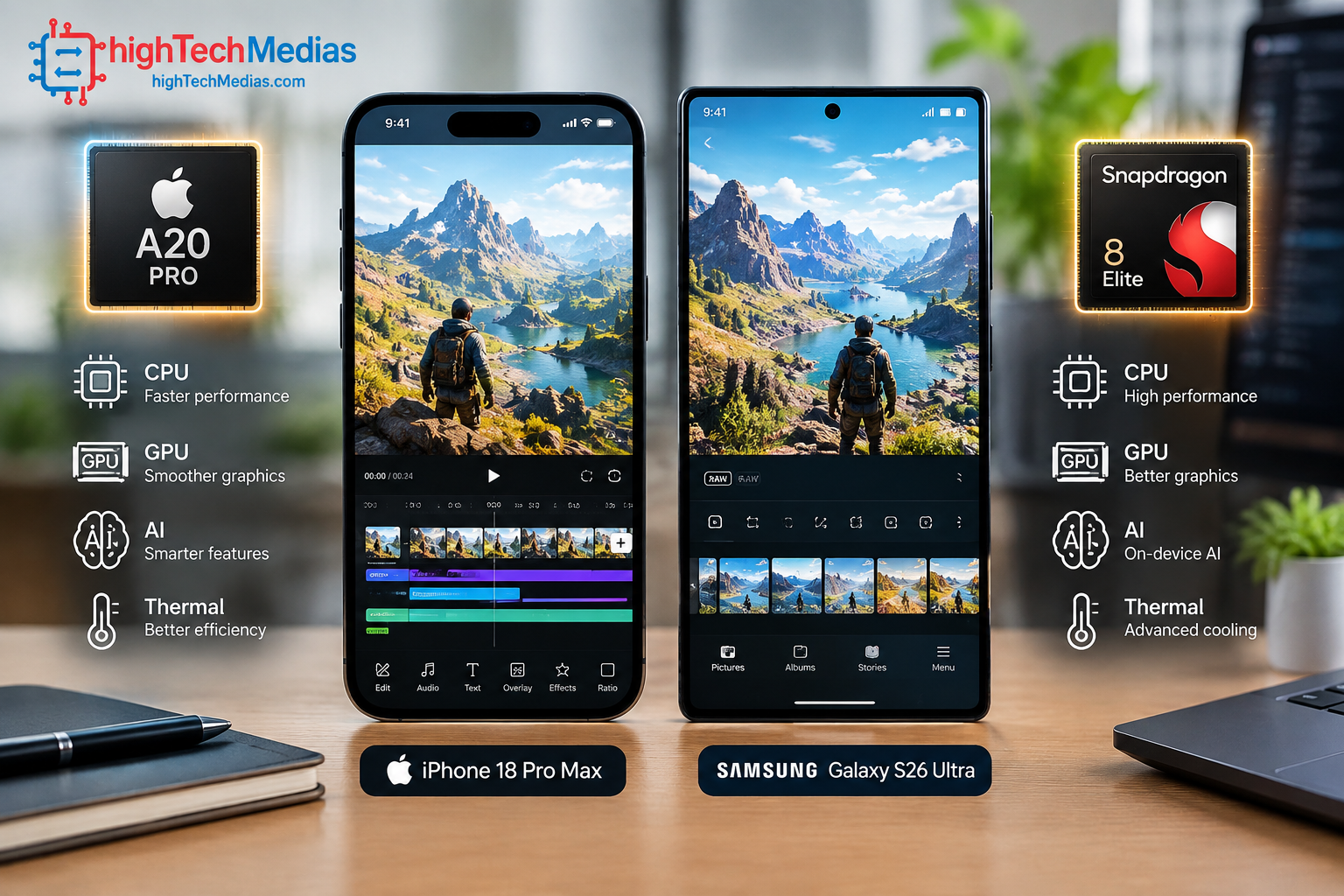
Apple equips the iPhone 18 Pro Max with its A20 Pro chip. Apple describes it as a major performance-generation upgrade and pairs it with a next-generation vapor chamber designed to support sustained performance. The A20 Pro includes a six-core CPU, seven-core GPU with Neural Accelerators, and dual 16-core Neural Engines.
Samsung uses a customized Snapdragon 8 Elite Gen 5 for Galaxy processor. Samsung says the platform includes an improved CPU, GPU, and NPU and can deliver up to 19% faster processing. Samsung also redesigned the Galaxy S26 Ultra’s vapor chamber, claiming a 21% improvement in thermal performance.
These specifications make both devices suitable for demanding workloads, including mobile gaming, high-resolution video editing, multitasking, photography processing, and on-device AI tasks.
For buyers who care about benchmark performance, independent testing is more useful than simply comparing processor names. The iPhone 18 Pro series has already demonstrated very strong CPU and GPU performance in third-party testing, while Samsung’s flagship platform remains highly competitive in demanding Android workloads.
For everyday users, however, both phones provide substantially more processing power than most normal smartphone tasks require.
5. Camera Comparison
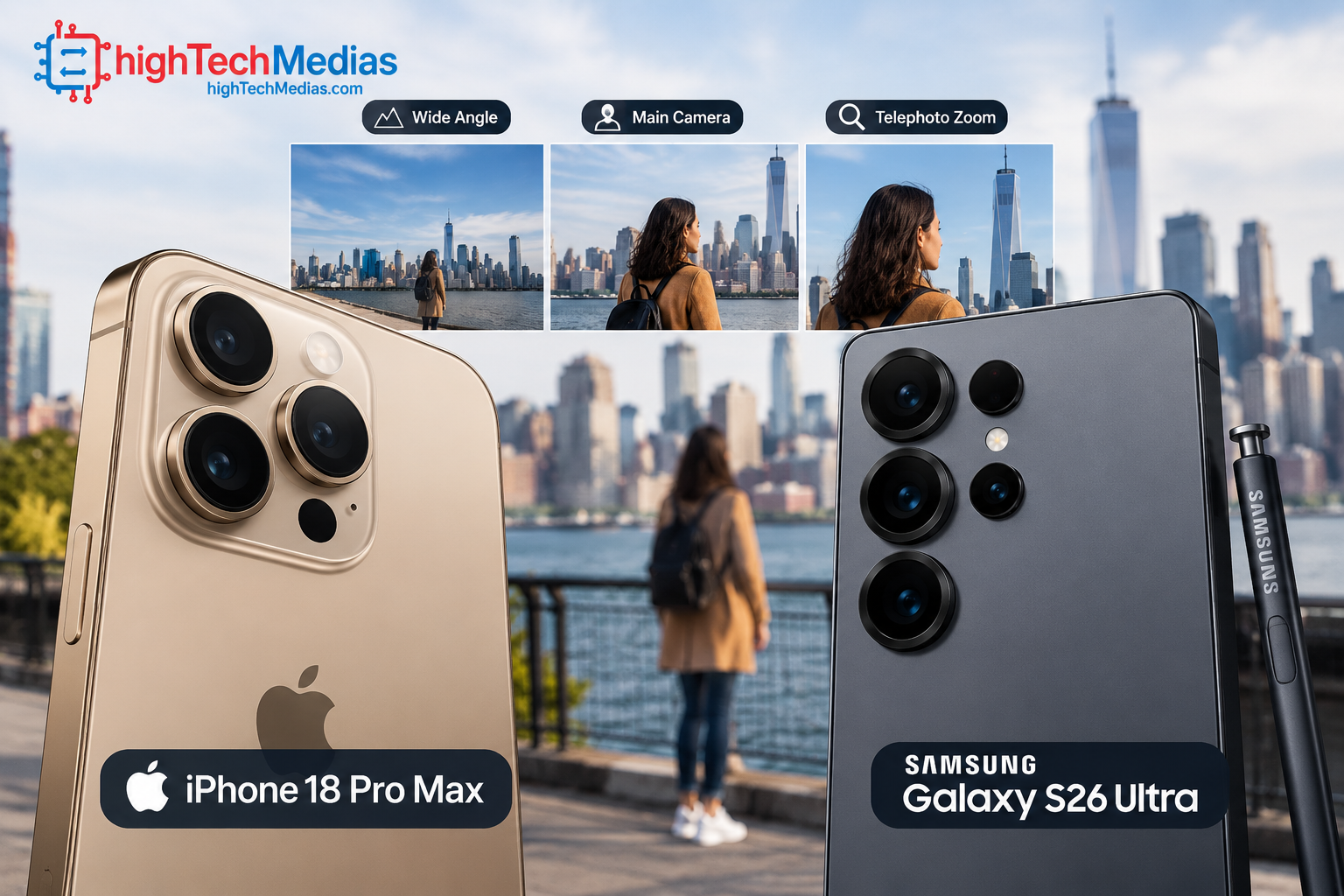
Camera performance is one of the clearest differences between these two flagship smartphones.
iPhone 18 Pro Max camera
The iPhone 18 Pro Max uses a 48MP Pro Fusion camera system. Its main camera introduces a variable aperture ranging from f/1.48 to f/4.0, allowing the camera to adjust the amount of light entering the lens and giving photographers greater control over depth of field. Apple also provides a 48MP ultra-wide camera and a 48MP telephoto camera with 4x optical magnification.
Apple also focuses heavily on video. The phone supports 4K Dolby Vision recording at up to 60fps, ProRes recording, ProRes RAW, Apple Log 2, Cinematic mode, and advanced stabilization features.
Samsung Galaxy S26 Ultra camera
Samsung takes a different approach.
The Galaxy S26 Ultra features a 200MP f/1.4 wide camera, a 50MP f/1.9 ultra-wide camera, a 50MP f/2.9 telephoto camera with 5x optical zoom, and a 10MP f/2.4 telephoto camera with 3x optical zoom.
This gives Samsung a particularly versatile multi-camera system. The 5x telephoto camera is useful for distant subjects, while the additional 3x telephoto camera provides another native focal length.
The iPhone’s variable aperture is an important new feature because it gives the main camera additional control over light and depth of field. Samsung’s advantage is the breadth of its zoom system and high-resolution 200MP main sensor.
6. Zoom and Photography Versatility
If zoom photography is a major priority, the Galaxy S26 Ultra has a particularly strong hardware configuration.
Samsung provides both 3x and 5x telephoto cameras, while the 200MP main sensor supports additional high-resolution cropping and optical-quality zoom modes. Samsung’s camera system is therefore designed around multiple native focal lengths.
The iPhone 18 Pro Max uses a 48MP telephoto camera at 100mm with 4x optical magnification. Apple also provides a 2x optical-quality option from the main sensor.
This difference matters if you frequently photograph distant subjects such as buildings, wildlife, sports, concerts, or travel scenes.
For everyday photography, however, the quality of the complete imaging pipeline matters more than megapixel counts alone. Image processing, autofocus, stabilization, HDR, exposure, color reproduction, and lens quality all influence the final photograph.
7. Video Recording
The iPhone has traditionally placed considerable emphasis on professional video, and the iPhone 18 Pro Max continues that approach.
Apple supports 4K Dolby Vision video at multiple frame rates, ProRes, ProRes RAW, Apple Log 2, Cinematic mode, and advanced stabilization. It also introduces additional post-capture cinematic controls.
Samsung also provides extensive video capabilities, including advanced stabilization and AI-assisted camera functions.
For users creating social-media videos, YouTube content, professional clips, or commercial footage, the iPhone’s combination of ProRes, Log recording, external recording support, and Apple’s video ecosystem makes it a particularly serious mobile video platform.
8. Battery Life and Charging
Battery life is another area where the specifications should be interpreted carefully because Apple and Samsung report battery performance differently.
Apple does not publish the iPhone 18 Pro Max’s battery capacity in its standard technical specifications. Instead, Apple reports up to 30 hours of use per charge and up to 45 hours of video playback. Apple also says the phone can gain up to seven hours of video playback from a five-minute charge.
Samsung lists a 5,000mAh battery for the Galaxy S26 Ultra and claims up to 31 hours of video playback. Samsung’s Super Fast Charging 3.0 can reach approximately 75% charge in around 30 minutes under its stated conditions.
The important point is that these are manufacturer measurements using different testing methods, so the numbers should not be treated as directly equivalent.
The iPhone 18 Pro Max is designed around high efficiency and long endurance, while Samsung provides a large published battery capacity and faster charging capability.
9. AI Features
AI has become a central part of flagship smartphones.
The iPhone 18 Pro Max runs iOS 27 and includes the next generation of Apple Intelligence and Siri AI. Apple describes Siri as becoming more contextual, conversational, and capable of understanding personal context and on-screen information.
Samsung’s Galaxy S26 Ultra integrates Galaxy AI across the phone, including camera assistance, productivity features, and other intelligent functions. Samsung also highlights its customized processor and improved NPU as important components of its AI strategy.
The two approaches are different.
Apple emphasizes integration between AI, iOS, apps, privacy, and the broader Apple ecosystem. Samsung emphasizes AI-powered customization, camera tools, productivity, and integration throughout One UI.
Which approach is more useful depends heavily on the applications and ecosystem you already use.
10. Software and Ecosystem
The software difference may ultimately matter more than several hardware specifications.
The iPhone 18 Pro Max runs iOS 27. It integrates closely with Apple’s ecosystem, including Macs, iPads, Apple Watch, AirPods, iCloud, and other Apple services.
The Galaxy S26 Ultra runs Android with Samsung’s One UI software and integrates with Samsung’s ecosystem, Google services, Windows connectivity features, Galaxy wearables, and Samsung’s productivity tools.
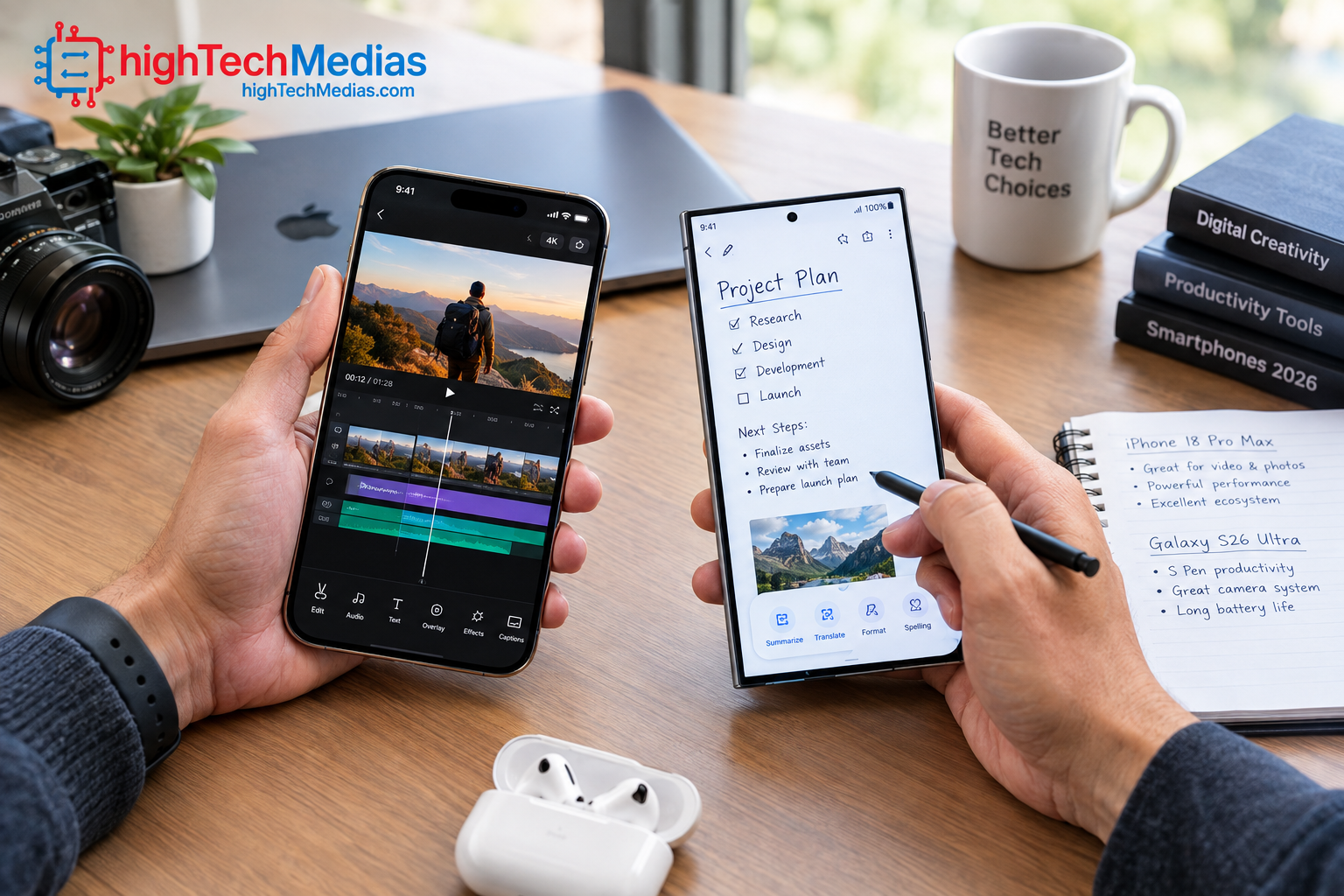
Samsung also has a major productivity advantage through the built-in S Pen. Samsung says the S Pen supports note-taking, handwriting-to-text, translation, AI Select, and other functions.
For a buyer already using a MacBook, Apple Watch, AirPods, or iPad, the iPhone can fit naturally into that environment.
For someone using Windows PCs, Samsung devices, Google services, or who wants more customization, the Galaxy ecosystem may be more appropriate.
11. Productivity and Multitasking
The Galaxy S26 Ultra has several features that make it attractive as a productivity device.
The S Pen allows quick notes and precise interaction with the display. Samsung also supports a wide range of multitasking features through One UI.
The iPhone does not include a built-in stylus, but its strength lies in the integration of hardware, software, apps, video tools, and Apple’s ecosystem.
For users who primarily communicate, browse, email, edit documents, and use social media, either phone has more than enough performance.
For people who regularly take handwritten notes or want a stylus integrated into the phone, Samsung has a clear hardware distinction.
12. Storage Options
Apple offers the iPhone 18 Pro Max in 256GB, 512GB, 1TB, and 2TB capacities.
Samsung offers the Galaxy S26 Ultra in 256GB, 512GB, and 1TB versions. The 1TB configuration is also available with 16GB RAM, while the 256GB and 512GB versions have 12GB RAM.
For buyers who record large amounts of 4K video, store extensive photo libraries, or install many large games, the higher storage configurations can become important.
The iPhone has the advantage if you specifically want a 2TB internal-storage option.
13. Connectivity
Both phones support modern connectivity standards.
The iPhone 18 Pro Max supports 5G, Wi-Fi 7, Bluetooth 6, USB-C, and other modern wireless technologies. Its USB-C port supports USB 3 speeds up to 10Gbps and DisplayPort functionality.
The Galaxy S26 Ultra also provides 5G, Wi-Fi 7, Bluetooth connectivity, and USB-C.
Both therefore provide the connectivity expected from premium 2026 smartphones.
For professional users who frequently transfer large video files, USB performance and ecosystem compatibility can be more important than the headline wireless specifications.
14. Price and Value
The iPhone 18 Pro Max starts at $1,299 in the United States for 256GB. Apple also offers 512GB, 1TB, and 2TB configurations.
The Galaxy S26 Ultra launched at $1,299.99 for 256GB. Samsung’s U.S. store currently lists promotional pricing that can reduce the 256GB model to $1,099.99, while the 512GB and 1TB configurations are also discounted at the time of checking. Promotional pricing can change.
This means shoppers should distinguish between launch price and current retail price.
If you are writing a comparison that will remain online for several months, it is better to state the manufacturer’s starting price and then separately mention that retailer promotions may change.
15. iPhone 18 Pro Max vs Samsung Galaxy S26 Ultra: Which Camera System Fits You?
The choice depends on how you use the camera.
Choose the iPhone approach if you prioritize:
- Professional video recording
- ProRes and ProRes RAW
- Apple Log 2
- Variable-aperture main camera
- Apple’s photo and video ecosystem
- Consistent integration with iOS
Consider Samsung if you prioritize:
- Multiple native telephoto cameras
- 5x optical zoom
- 200MP main camera
- Extensive camera controls
- AI-assisted photography
- Flexible Android photography tools
Samsung’s 200MP main sensor and 5x telephoto system make it particularly versatile for zoom-oriented photography, while Apple’s variable aperture and extensive professional video tools make the iPhone attractive for creators.
16. Which Phone Is Better for Gaming?
Both phones are powerful enough for demanding mobile games.
The iPhone 18 Pro Max combines the A20 Pro processor with a next-generation vapor chamber designed to improve sustained performance. Apple also includes hardware-accelerated ray tracing.
Samsung uses the Snapdragon 8 Elite Gen 5 for Galaxy and a redesigned vapor chamber that Samsung says improves thermal performance by 21%.
The practical difference will depend on the individual game, optimization, graphics settings, thermal conditions, and software updates.
Neither phone should be purchased solely because of its processor name. For serious gaming, consider the complete system, including cooling, display refresh rate, battery endurance, charging speed, game optimization, and controller compatibility.
17. Which Phone Should You Buy?
The decision becomes easier when you start with your priorities.
Choose the iPhone 18 Pro Max if:
You already use Apple products and want deep ecosystem integration.
You frequently record professional-quality video and want features such as ProRes, ProRes RAW, Apple Log 2, and advanced stabilization.
You want up to 2TB of internal storage.
You prefer iOS and Apple’s approach to software and privacy.
You want a large 6.9-inch display combined with the A20 Pro platform.
Choose the Galaxy S26 Ultra if:
You prefer Android and extensive customization.
You want a built-in S Pen.
You regularly use the phone for handwritten notes and productivity.
You prioritize long-range photography and multiple telephoto cameras.
You want Samsung’s built-in Privacy Display.
You prefer faster wired charging and a published 5,000mAh battery capacity.
18. Frequently Asked Questions
Is the iPhone 18 Pro Max more expensive than the Galaxy S26 Ultra?
Their U.S. starting prices are very close. The iPhone 18 Pro Max starts at $1,299, while the Galaxy S26 Ultra launched at $1,299.99. Retail promotions can change the actual purchase price.
Which has the better camera, iPhone 18 Pro Max or Galaxy S26 Ultra?
They emphasize different strengths. The iPhone 18 Pro Max introduces a 48MP main camera with variable aperture and extensive professional video capabilities. The Galaxy S26 Ultra uses a 200MP main camera and multiple telephoto cameras, including a 5x optical telephoto.
Does the Galaxy S26 Ultra have an S Pen?
Yes. The S Pen is integrated into the Galaxy S26 Ultra and supports notes, handwriting, translation, screen interaction, and other productivity features.
Which has the larger display?
Both the iPhone 18 Pro Max and Galaxy S26 Ultra have 6.9-inch displays. Their display technologies and feature sets differ. Apple’s phone uses Super Retina XDR OLED, while Samsung uses Dynamic AMOLED 2X.
Which has better battery life?
Manufacturer claims are measured differently. Apple rates the iPhone 18 Pro Max for up to 30 hours of use and up to 45 hours of video playback. Samsung rates the Galaxy S26 Ultra for up to 31 hours of video playback. These numbers should not be treated as directly equivalent.
Does the iPhone 18 Pro Max support Wi-Fi 7?
Yes. Apple’s specifications list Wi-Fi 7 with 2×2 MIMO for the iPhone 18 Pro Max.
How much storage does the iPhone 18 Pro Max have?
The iPhone 18 Pro Max is available with 256GB, 512GB, 1TB, and 2TB storage options.
How much RAM does the Galaxy S26 Ultra have?
Samsung lists 12GB RAM for the 256GB and 512GB models and 16GB RAM for the 1TB version.
19. Final Verdict
The iPhone 18 Pro Max vs Samsung Galaxy S26 Ultra comparison does not produce a single specification-based answer because these phones are designed around somewhat different priorities.
The iPhone 18 Pro Max combines the A20 Pro processor, a 6.9-inch Super Retina XDR display, a new variable-aperture 48MP main camera, extensive professional video capabilities, long battery-life claims, and deep integration with Apple’s ecosystem.
The Galaxy S26 Ultra combines a 6.9-inch Dynamic AMOLED 2X display, Snapdragon 8 Elite Gen 5 for Galaxy, a 200MP main camera, 3x and 5x telephoto cameras, a 5,000mAh battery, fast charging, built-in Privacy Display technology, and an integrated S Pen.
For someone already invested in Apple’s ecosystem or focused heavily on professional mobile video, the iPhone 18 Pro Max provides a highly integrated experience.
For someone who values Android customization, long-range photography, S Pen productivity, Privacy Display technology, and fast charging, the Galaxy S26 Ultra offers a different set of strengths.
The most useful way to make the decision is therefore not to ask which phone has the longest specification list. Instead, consider the features you will actually use every day: camera style, video recording, battery behavior, charging, software ecosystem, productivity tools, storage, and connectivity.
Both are flagship smartphones designed for demanding users, and either can serve as a powerful long-term device. The better choice for you depends primarily on which ecosystem and feature set fits your existing devices, workflow, and priorities.


Leave a Reply